
Locally owned · Fully insured · 50+ five-star reviews
Blog
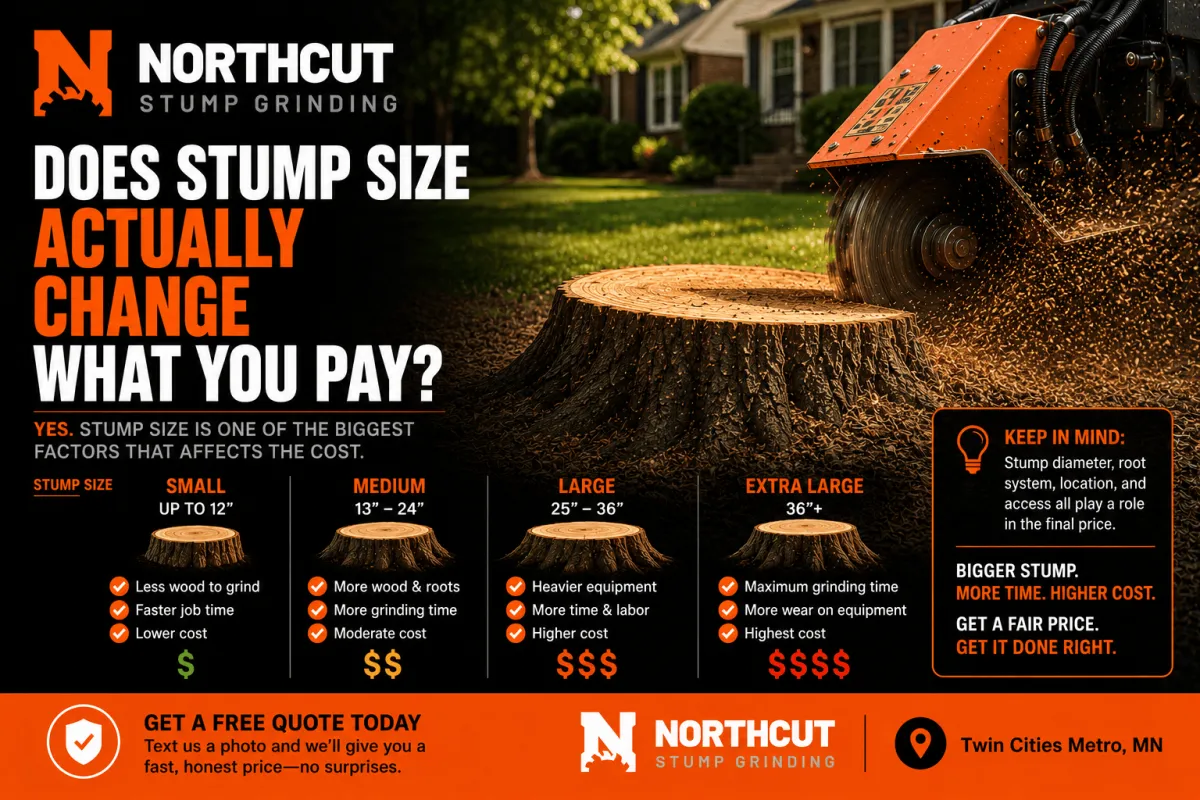
Does Stump Size Actually Change What You Pay?
Size Is the Biggest Variable — But Not the Only One
The short answer is yes — stump size is the most consistent pricing factor in stump grinding. But size is more nuanced than it sounds. It’s not just the diameter you can see at the top of the stump, and it doesn’t tell the whole story on its own. Here’s a practical breakdown of how size translates into price and what else you need to account for.
Why Diameter Drives Stump Grinding Prices
Stump grinding is fundamentally a volume problem. The bigger the stump, the more wood the machine has to remove, the longer it runs, and the more wear it puts on cutting teeth — which are a significant ongoing expense for any stump grinding operator. A 10-inch stump in an average residential yard might take 15 to 20 minutes to grind. A 30-inch oak can take 45 minutes to an hour or more.
That time difference represents labor, fuel, and machine wear. Pricing by diameter is the industry’s way of making sure the price reflects the actual work involved.
How to Measure Your Stump Correctly
An accurate measurement before you request a quote saves back-and-forth and leads to a more reliable price. Follow these three steps.
Find the widest point of the stump at ground level. This is often wider than the cut at the top of the trunk.
Measure across — not the circumference, but the straight-line diameter at the base.
If sending a photo, include something for scale: a hand, a shoe, or a tape measure in the frame.
Many trees flare significantly at the base, meaning the actual grinding area is larger than the cut diameter suggests. A trunk that measures 16 inches at the cut can be 24 inches at ground level.
Size Ranges and What They Typically Cost in the Twin Cities
The table below reflects realistic price ranges for single-stump residential jobs in the Twin Cities, Minnesota under standard access conditions and standard grind depth.
What Diameter Alone Doesn’t Tell You
Two stumps with identical diameters can have very different prices depending on the following conditions. Each one can push a quote toward the higher end of its range or beyond it.
Surface root spread. Extensive lateral roots require additional grinding time beyond the main stump.
Wood density. A 20-inch oak is harder to grind than a 20-inch poplar.
Grind depth. A deep grind to 12–14" roughly doubles the material removed compared to standard depth.
Access difficulty. Getting the machine to the stump affects time and therefore cost.
Mounding. Raised ground around the base adds material that needs to be addressed.
A quote that accounts only for diameter and ignores these factors will often be inaccurate. The best quotes come from operators who look at a photo carefully and ask about site conditions before committing to a price.
Frequently Asked Questions
Is there a minimum charge even for very small stumps?
Yes. Most reputable stump grinding companies have a minimum in the $150–$200 range regardless of stump size. This covers the fixed costs of any job: travel, equipment setup, utility locates, and the operator’s time.
Do multiple small stumps cost less than one large stump?
Not necessarily less in total, but the per-stump cost drops when multiple stumps are done in one visit. Three 10-inch stumps will cost more than one, but less than three separate minimum-charge jobs. Grouping is always more economical.
How does a stump’s height above ground affect price?
Height above ground matters less than diameter at the base. Some operators cut a tall stump down to a lower height before grinding to reduce machine time. Ask whether this is included if you have a stump significantly raised above grade.
Does grinding to a deeper depth significantly increase cost?
Yes. Deep grinds to 12–14 inches below grade roughly double the volume of material removed compared to a standard 4–6 inch grind. Expect a meaningful price difference — typically 30–60% more than the standard depth quote for the same stump.
Can I get an accurate quote without measuring the stump myself?
A clear photo is usually sufficient. Include something for scale if possible. Experienced operators in the Twin Cities, Minnesota often prefer photos over descriptions because they can see access conditions, root spread, and mounding as well as diameter.
Bottom Line
Stump size is the clearest predictor of what you’ll pay, but it’s one input among several. The most accurate quotes come from operators who evaluate the full picture: diameter, roots, access, and what you plan to do with the space afterward.
NorthCut Stump Grinding assesses each job individually and provides a flat price based on everything visible in a photo. Text (612) 440-7641 with a photo of your stump anywhere in the Twin Cities, Minnesota and you’ll have an honest number within a few hours.

Copyright 2026. NorthCut Stump Grinding. All Rights Reserved.
Website Done By: LocalEyes